

President Joko Widodo recently officiated a high-speed railway project worth Rp113 billion, connecting Jakarta and Bandung. This 142-kilometer railway is a key part of President Jokowi’s infrastructure agenda and associated with China’s Belt and Road Initiative. This project has came across many challenges, such as land acquisition problems, pandemic-related delays, and escalating costs. The launch of the bullet train, namely “WHOOSH” which stands for “Waktu Hemat Operasi Optimal Sistem Hebat”, took place much later than the original target of 2019. According to Jokowi, the train’s name is inspired by the sound of a speeding high-speed train. He emphasized its potential to modernize environmentally friendly mass transportation, with a maximum speed of 350 kilometers per hour (217 mph). Prior to its official opening, authorities conducted public trials for the 142-kilometer high-speed route. Jokowi has confirmed that he will not provide tariff subsidies for KCJB. He admits that he is not yet certain about the exact fare to be set and has delegated this matter to PT Kereta Cepat Indonesia China (KCIC).Meanwhile, PT Kereta Cepat Indonesia China (KCIC) has proposed WHOOSH train fares ranging from Rp250,000 to Rp350,000 for a single journey. KCIC GM Corporate Secretary, Eva Chairunisa, mentioned that the proposed fares of Rp250,000 to Rp350,000 apply to three classes: premium economy, business, and first class. However, Eva stated that they have only submitted this proposal to the government and are still in the process of calculation, so the exact fare for the high-speed train cannot be confirmed at this time. Source: cnnindonesia.com, thejakartapost.com

Ticketmaster Strategy to Clamp Down on Scalpers in Olivia Rodrigo ‘Guts’ Concert
Amid the expected chaos of the on-sale for Olivia Rodrigo’s “Guts” tour is an unusual caveat: In an attempt to crack down on scalpers, purchased tickets will only be issued 72 hours before the concert takes place, regardless of when they were purchased — and they will only be available electronically. The decision was taken by the tour’s operators as ‘as an added level of protection’, with Ticketmaster facilitating the strategy. In a statement, Ticketmaster told Good Morning America: ‘Delivery delays are commonly used by artists to allow for a thorough review of the sale and to ensure all ticket purchasers have adhered to ticket limits and terms.’ While the 72-hour rule may appear novel to many, insiders suggest that it has been employed previously for tours by artists such as Ed Sheeran, Jack Harlow, and Doja Cat, among others. Nonetheless, it remains unclear how this measure will effectively address the issue of ticket scalping, especially considering that secondary ticketing platforms often trade in “speculative” tickets (a concern Live Nation has been trying to tackle through the FAIR Ticketing Act). Additionally, there is the potential for a frenzied rush in the secondary market once the three-day limit elapses. Despite the addition of 20 extra tour dates, all available slots have already been snapped up. This action represents the most recent effort made by the major ticketing company to confront the exploitative secondary ticket market. It follows a series of significant issues experienced by fans when attempting to purchase tickets for Taylor Swift’s “Eras” tour last autumn, including server malfunctions and fans enduring long online waiting times, often with no success. Ticket prices on the secondary market even reached five figures, leading to such a significant outcry that Joe Berchtold, the Chief Financial Officer of Ticketmaster’s parent company, Live Nation, was summoned to appear before Congress.

iPhone 15 Unveiled: A Visual Journey through #ShotoniPhone Collaborations
Apple will be releasing the awaited products, the iPhone 15 and iPhone 15 Pro on September 22nd, 2023. Upon the release of the iPhone 15, Apple joined forces with music sensation Olivia Rodrigo to shoot a music video. The “Get Him Back” music video, one of the tracklists in Olivia’s newest album, was shot on iPhone 15 Pro. These ads were under the campaign #ShotonIphone. The collaboration succeeded in increasing people’s curiosity about the phone, especially the camera. Since the release of the music video, there have been a lot of articles talking about the collaboration. Not just that, people all over the internet started to share their reactions and thoughts on Olivia’s new song and iPhone 15 Pro’s camera. This collaboration for #ShotonIphone was not the first. Earlier this year, in July, Apple collaborated with a rookie girl group from South Korea, NewJeans. The music video for “ETA” was entirely shot on iPhone 14 Pro. The music video succeeded in generating more than 30 million views. It became the talk of the town, particularly among K-pop fans. However, NewJeans music video was also not the first, Selena Gomez’s “Lose You to Love Me” music video was one of the first MVs shot on an iPhone in 2019. The campaign #ShotoniPhone was first started back in March 2015 to promote the iPhone 6. The campaign was originally made for outdoor advertising (read “billboards”). The idea for the campaign was based on customer behavior where people post their photos and hash tagging them in different ways. The campaign proved to be a success for Apple to expand it beyond billboards. The billboards featuring photos captured with iPhones were created to enhance not just the phone’s camera(s) but also the aesthetic appeal of the billboard’s vicinity. According to Tor Myhren, Apple Vice President, this campaign also talked about how this campaign could enhance the area of the billboards, making it captivating and attractive rather than intrusive and bothersome. In the following years, Apple started giving out challenges to customers to capture photos with their iPhones. Furthermore, Apple also gave out instructions on how to utilize the camera. Apple’s guidance on camera utilization catalyzed users to explore the diverse possibilities of photography and videography using their iPhones. Moreover, Apple collaborated with numerous artists to create a great number of short movies, music videos, photoshoots, and many more, with stunning photography and filmography.

From Scrolling to Splurging: Riding the Socio-Commerce Wave with TikTok Live Shopping
In the ever-evolving landscape of e-commerce, TikTok Live Shopping has emerged as a game-changer. As users worldwide scroll through their feeds, they are now not only entertained but also tempted to buy products they discover through live shopping events. This is the rise of socio-commerce, where social media platforms like TikTok bridge the gap between online shopping and social interaction. TikTok Live Shopping stands out due to its real-time interaction and infusing authenticity into the online shopping experience. Entertaining content keeps viewers engaged, while influencers leverage their followings to boost sales and brand loyalty. The seamless transition from browsing to buying within the app ensures convenience, and limited-time offers create a sense of urgency for impulse purchases. TikTok Live Shopping’s marketing power shines through its targeted advertising, driven by the platform’s data-driven algorithm. User-generated content from satisfied customers serves as powerful testimonials, fostering organic engagement and sales. Time-sensitive promotions, like flash sales, thrive in the live shopping format, capitalizing on the sense of urgency to drive conversions. Dr. Richard Lee, a beauty brand owner, shares his remarkable success story, having generated over 40 billion Rupiah in revenue through TikTok Live Shopping. This achievement attributes to the platform’s real-time interaction and entertainment factor, which captivated viewers and encouraged impulse purchases. His testimonial underscores the immense potential for businesses, both large and small, to thrive on this platform. Source: ads.tiktok.com

Behind Indonesia’s Hosting Agenda in FIBA World Cup 2023
Indonesia is all set on the agenda of becoming the host country for the International Basketball Federation (FIBA) World Cup 2023, alongside Japan and the Philippines. The tournament was held in Indonesia Arena, Jakarta, from August 25 to September 10 2023. The world cup in Jakarta will host the elimination round of two groups, namely Group G and Group H. Group G consists of Spain, Iran, Ivory Coast, and Brazil while Group H consists of Canada, Latvia, Lebanon, and France. In fact, this is also the first time for Indonesia to host the FIBA Basketball World Cup, FIBA’s flagship event. The tournament was held at Indonesia Arena, a newly-built multi-purpose indoor arena at the Gelora Bung Karno (GBK) Sports Complex in Jakarta. The Indonesia Arena itself is built specifically for the FIBA Basketball World Cup 2023. Following the principles of green construction, the Arena has embraced a weaving philosophy, symbolizing the Indonesian populace’s spirit of Gotong Royong, where diversity comes together to create a resilient nation. This arena has a capacity of 16.000 people and they can expect nothing but a premium and state-of-the-art modern experience. The world cup turns out to be very spectacular. Based on data from ticket sales during the 10 days of implementation, the number of spectators for the two qualifying rounds of the 2023 FIBA World Cup in Jakarta reached a total of 139,032 people. If you add FIBA guests, sponsors and invitees, the total number of spectators can reach almost 150,000 people. “The total number of stadium attendees reached 111,000, making it the highest in the history of Indonesian basketball. It’s also the largest crowd compared to the games played in Japan and the Philippines,” stated Erick Thohir, Indonesian State-Owned Enterprise Minister. Additionally, he mentioned that the FIBA World Cup 2023 affords Indonesia an opportunity for favorable global visibility, with all matches being broadcast live worldwide. FIBA officials have also praised Indonesia for the successful organization of the qualifiers. Source: Jakarta Globe, Republika

Transforming Jakarta’s Commute: President Unveils New LRT System to Tackle Traffic and Pollution
Indonesia’s President Joko Widodo has formally introduced the Greater Jakarta Light Rail Transit (LRT) system, aimed at countering traffic congestion and environmental pollution in the capital. Covering a 42-kilometer expanse and connecting Jakarta to satellite cities via 18 stations, the LRT endeavors to foster a shift towards public transportation, alleviating Jakarta’s traffic and pollution conundrums. This endeavor complements preexisting mass transit alternatives and represents a substantial stride toward nurturing sustainable urban mobility. Despite grappling with delays due to financial and land procurement challenges, the LRT infrastructure is now operational, ready to accommodate approximately 500,000 daily commuters. When coupled with other transit services, this cumulative capacity has the potential to escalate to an impressive 1.7 million passengers per day. While capitalizing on automated technology, the presence of human operators for troubleshooting purposes persists. Beyond mere convenience, the comprehensive public transportation matrix seeks to imbue cultural transformations concerning punctuality and hygiene among the Indonesian populace. Future strategies encompass extending the LRT network to encompass neighboring territories, amplifying connectivity and influence. President Joko Widodo’s inauguration of the unified Light Rail Transit (LRT) system for the Greater Jakarta precinct underlines cooperative endeavors to surmount traffic congestion while nurturing sustainable urban mobility. Embracing an autonomous operational model, the LRT architecture spans 42 kilometers and incorporates 18 stations, extending an eco-friendly travel choice. This drive aligns harmoniously with the administration’s commitment to addressing congestion and pollution while administering efficient transportation resolutions. Conversations have been initiated about broadening the LRT reach to include neighboring regions, reflecting the project’s triumph and potential for wider ramifications. Source: The Jakarta Post, Dephub.go.id

F1 : Digital Marketing to The Rescue
This week marks the end of summer break for all of the F1 teams. Everyone is back on preparing for another Grand Prix on August 27th in the Netherlands. Talking about Formula 1, there are many interesting topics that we could start from. One of the most interesting and also crucial about F1 is actually their marketing strategy. F1 is a marketing driven sport that relies on funds raised through sponsorship and marketing to support the sport financially. Though being the most famous motorsport in the world, F1 faced a turbulence in gaining the audience’s attention and outreach to audiences back in early 2010s. Before 2016, fans engagement was constantly declining with many fans complaining about limited access to F1 on digital platforms. But things took a turn when Liberty Media purchased F1 and started to solve problems surrounding lack of interest in the audience. Before Liberty Media came to the stage, there was no formal marketing, promotion, sponsorship, or research departments. Under the hand of Chase Carey, the new appointed lead for F1, F1 pivoted to enter digital marketing. There were a lot of digital marketing strategies involved to overcome the ongoing struggles, for example the usage of social media. F1 started to be more active on various social media platforms, such as instagram, twitter, youtube, and recently on tiktok. The contents varied from fun and interesting challenges or questions for drivers to educational knowledge on F1. In the world of Formula 1, a plethora of technical terms are employed—such as ‘apex,’ ‘DRS,’ ‘flatspot,’ and more—that might seem overwhelming to casual viewers. For this reason, F1 started to create educational content about these terminology. Not only that, they would share unpublished photos or moments that were not shown on tv screen. All of these activities on social media were a success to generate old fans and new fans attention to the sport. Another marketing strategy used in gaining new viewers interest to the sport was by entering Netflix with a docuseries called “Drive to Survive”. The series portrayed behind the scenes of constructors and drivers to win the championship. Stories and dramas told in the series were able to appeal to new viewers into the sport. The series was such a success that it was already planned to shoot for six seasons. These narratives proved success to drive a new wave of younger generation fans to the surface. The decision to integrate digital marketing into the sport proved to be a resounding success. Following the launch of its marketing campaign in 2017, Formula 1 witnessed an impressive 209 percent surge in sales compared to the fan base before the initiation of the social media push. Beyond that, a substantial influx of new fans, comprising 61 percent within the under-35 age group and 25 percent aged between 16 and 24, revitalized the sport. This surge in young fans not only renews hope for sustained popularity but also ensures the continual growth of the sport’s fanbase.
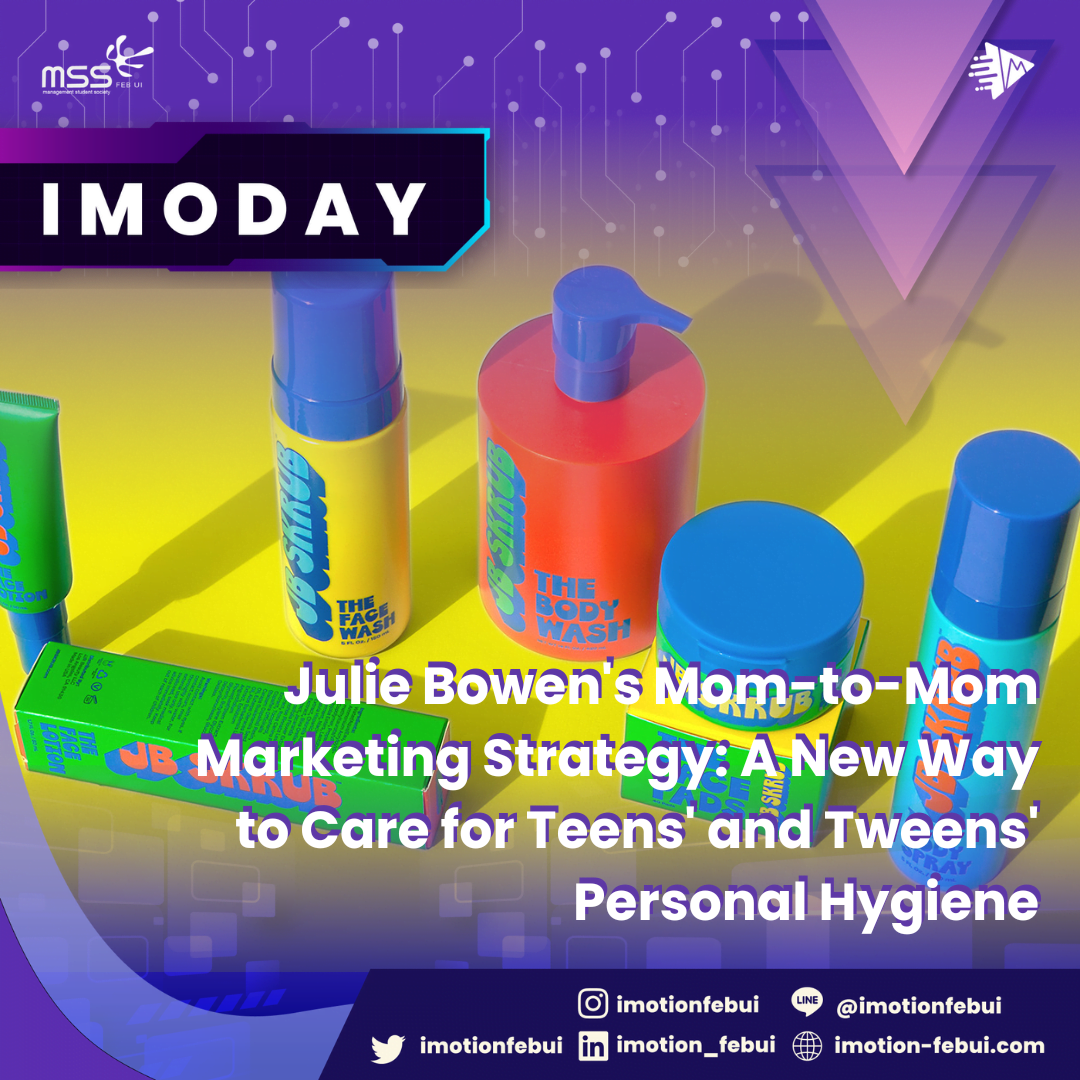
Julie Bowen’s Mom-to-Mom Marketing Strategy: A New Way to Care for Teens’ and Tweens’ Personal Hygiene
Do you remember Claire from the hit TV show Modern Family? Well, Julie Bowen, the actress behind that loving mother character has embarked on a new journey. Inspired by her own experiences as a mother to stinky teenage sons, she launched her personal care and hygiene brand “JB SKRUB”. What’s truly intriguing about this brand is its genius mom-to-mom marketing strategy. Here’s the twist – while the products are designed for young males, the key consumers are often mothers, who make the purchasing decisions for those under 18. This is where the brand’s brilliance shines, it seamlessly bridges the gap between teenage users and the influential mothers who will be buying the products. Julie Bowen’s presence in the marketing materials is a stroke of brains. Beyond reminding consumers of the celebrity connection, it establishes a personal bond between the brand and potential buyers. This relatability factor goes a long way in building trust and resonating with moms looking for quality products. Furthermore, JB SKRUB’s reach isn’t limited to a specific region. Their products are available for purchase worldwide and their website offers automatic currency conversion, making it convenient for customers from different countries. This approach signals a commitment to catering to a diverse audience while maintaining a consistent brand experience. JB SKRUB not only addresses hygiene needs but also exemplifies a thoughtful and inclusive approach to parenting. “Nobody was teaching teen boys how to get clean. We develop this for them, but it can be used by anybody. It’s simple and meets their needs where they are” -Julie Bowen (Founder of JB SKRUB) Source: JB SKRUB

Beyond Barbenheimer: The Viral Fusion of Barbie and Oppenheimer that Redefined Movie Marketing
Imagine that two cinematic worlds colliding in a way that’s never been seen before. Picture Barbie and Oppenheimer, two films with completely different vibes and themes, sharing the spotlight in a groundbreaking double feature. The birth of ‘Barbenheimer’ in April 2022 was like a spark, not intended to ignite a social media storm, but more like a playful nod to the upcoming cinematic spectacle. Matt Neglia, the mastermind behind the term, shrugged off its viral potential, saying, ‘I never aimed for a hashtag or anything like that.’ Yet, the term caught fire faster than anyone could have predicted, spreading like wildfire across social platforms, capturing the imaginations of people worldwide. The excitement became a cultural phenomenon, leaving traditional marketing strategies in the dust as this runaway train of hype took over. But as the films stormed into theaters, reaching blockbuster status, a storm of a different kind brewed. Warner Bros.’ tweets promoting Barbie stirred up controversy in Japan, particularly one featuring Oppenheimer with Barbie against the backdrop of an atomic explosion. The backlash was real, with #NoBarbenheimer trending in Japan and the local Warner Bros. issuing a formal apology for the insensitivity. While the Barbenheimer craze is undeniably unprecedented and intriguing, some marketing moves have shown a lack of understanding and an unfortunate attempt to cash in on this historic entertainment moment. Warner Bros. expressed regret, stating, ‘We’re sorry for our thoughtless social media involvement.’ It’s a reminder that when two vastly different cinematic worlds collide, the nuances can get lost in translation. Despite the missteps, it’s important not to lose sight of the larger significance that Oppenheimer, with its blend of history and contemporary relevance, brings to the table in this unique chapter of cinematic history. Source: Collider

Elon Musk is Getting Rid of Iconic Internet Brand
For over a decade, Twitter has become one of the most recognizable social media brands with its bird decals adorning small businesses and websites globally, alongside Instagram and Facebook logos. Twitter has been famous for its blue and white bird logo, symbolizing the distinctive culture of this social network. We have immersed ourselves so much in it that verbs like “tweet” and “retweet” became a part of our modern culture. It would not last forever as Elon Musk, the tech billionaire who bought Twitter last year, rebranding the social platform as X.com on its website and started replacing the legendary bird logo with a stylized version of the letter X. This transformation extended to Twitter’s headquarters in San Francisco, where X logos were projected in the cafeteria, conference rooms were given new names featuring the letter X, and all bird-related paraphernalia was removed from the cafeteria. Elon Musk declared on his X account, “soon we shall bid adieu to the twitter brand and, gradually, all the birds” to hasten the process. Elon Musk himself has been interested in the X name for a long time. In 1999, he helped found an online bank called X.com. The company changed its name after it merged with another start-up to form what would become PayPal and he had repurchased the X.com domain in 2017. Tesla also has a sport utility vehicle called the Model X. The holding companies created to close the acquisition of Twitter were named X Holdings. Elon Musk also leads an artificial intelligence company called xAI. In one glance, Elon Musk has erased 15 years’ worth of brand value from Twitter. According to analysts and brand agencies, Musk’s decision resulted in the elimination of approximately $15 billion to $20 billion in value. X will require the company to rebuild that cultural influence and linguistic recognition from scratch. Nevertheless, X holds the potential to fulfill its brand’s essence. He personally hopes to transform Twitter into an “everything app” called X, encompassing not only social networking but also banking and shopping. Powered by an AI, X aims to connect people in ways we’re just beginning to imagine. Let’s just witness how all these developments unfold with Elon Musk and his ambitious everything app. Sources: NY Times, The Verge