
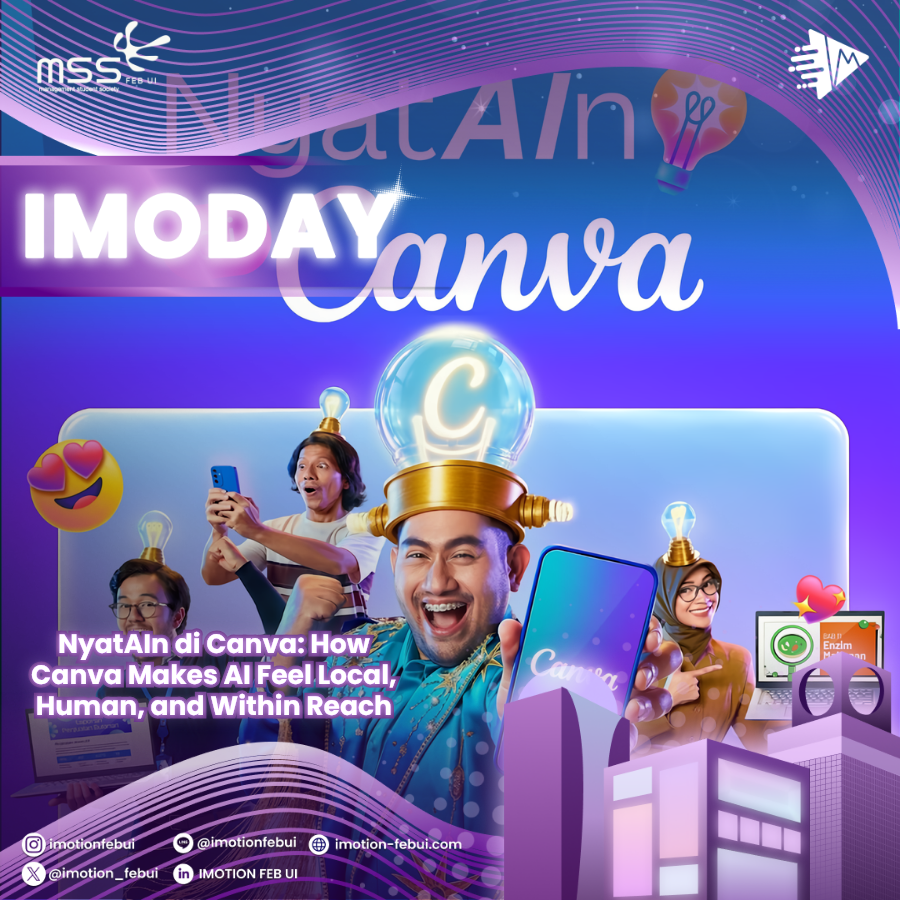
For many people, artificial intelligence still feels like something distant: technical, intimidating, and meant for professionals. In June 2026, Canva set out to change that perception in Indonesia. Its campaign “NyatAIn di Canva” is the platform’s first AI-focused brand campaign in the country, launched on June 25, just two days before World MSME Day. Instead of leading with features, Canva leads with a familiar feeling: being stuck before you even begin.
The campaign follows three everyday characters: an office worker struggling to finish a presentation, a teacher who wants to make lessons more engaging, and a small business owner unsure how to stand out. At the moment each of them freezes, singer King Nassar appears as the interruption that turns a stalled idea into a workable draft. The idea is simple, but it is carefully built.
What Makes the Campaign Attractive
Cultural Localization
Cultural localization is a strategy where a global brand adapts its message, language, and references to the culture of a specific market, so it feels like part of the local conversation rather than an import. Canva does this through its choice of face and hook. King Nassar’s well-known song “Seperti Mati Lampu” (like a power outage) becomes a metaphor for creative paralysis: the lights are out, and you cannot see where to start. A technical idea like AI is compressed into an expression every Indonesian instantly understands. The campaign also runs across national TV, YouTube, Instagram, TikTok, and out-of-home placements in Jakarta, Bandung, and Surabaya, backed by creators and communities.
AI as a Creative Partner, Not a Replacement
Canva’s own research found a confidence barrier: many people believed Canva was only for professional designers. So the campaign targets non-designers such as small business owners, teachers, and office workers, and positions AI as a partner that helps with the hardest part, taking the first step. Canva’s team stressed that AI is not meant to replace human creativity. This framing matters in a market where parts of the creative community have openly resisted AI-generated images.
Impact & Results
No performance figures for the campaign itself have been disclosed. Canva says it measures success by consideration, meaning whether audiences begin to think about using Canva AI, rather than by usage volume. The context explains why it matters: Indonesia is Canva’s third-largest market worldwide, and Indonesians created over one billion designs on the platform in 2025, roughly three million a day.
The campaign also builds on Canva’s earlier localized efforts, including its Ramadan campaign that turned warung awnings into billboards. Together they show a consistent approach: win trust by sounding local first, then introduce the technology.
Ultimately, “NyatAIn di Canva” shows that adopting new technology is as much an emotional challenge as a technical one. When a brand speaks the audience’s language, even AI can feel like a familiar friend.
Sources :
https://www.marketing-interactive.com/canva-launches-first-indonesia-ai-brand-campaign-with-king-nassar
https://www.campaignindonesia.id/article/canva-sasar-umkm-dan-non-desainer-dengan-kampanye-nyatain-di-canva/1966663
https://www.contentgrip.com/canva-indonesia-ai-campaign/
https://www.fortuneidn.com/business/canva-kian-kuatkan-kehadirannya-di-indonesia-via-kampanye-hiper-lokal-00-kptjc-8zm1fk
Written by Abednego Jhosan Marthlos Tewuh, Management 2025, Marketing The 20th IMOTION